





Description
Industrial buyers searching for C52100 bronze wire are usually balancing three requirements at once: mechanical strength that holds up in service, corrosion resistance that survives the working environment, and a supply chain that can document both. This review examines how bronze wire fits into the copper material family, which specification elements determine performance, how it is manufactured, and how Jiangsu Xinxiangsheng Special Steel Co., Ltd. positions itself for industrial manufacturing programs.
Bronze Inside the Copper Material Family
Industrially, copper materials are categorized by composition into two main groups: pure copper and copper alloys. Common alloys include brass (copper-zinc), bronze (copper-tin, copper-aluminum, etc.), and cupronickel (copper-nickel). Based on oxygen content and deoxidation method, pure copper is further subdivided into tough-pitch copper (electrolytic tough-pitch copper), oxygen-free copper, and phosphorus-deoxidized copper; oxygen content directly affects welding, formability, and resistance to hydrogen embrittlement, making it a key factor in material selection and technical inquiries.
- Pure Copper (Red Copper): Offers superior electrical and thermal conductivity; used for busbars, conductive components, heat exchangers, and water/gas piping. Representative grades: T1/T2/T3, TU1/TU2, TP1/TP2.
- Brass (Copper-Zinc Alloy): Features high strength, good machinability, and a golden-yellow appearance; used for tubing, hardware, valves, lighting fixtures, and connectors. Representative grades: H59–H80.
- Bronze / Cupronickel: Alloyed with elements such as tin, aluminum, or beryllium (bronze) or nickel (cupronickel); used for elastic components, wear-resistant parts, and applications in marine or corrosive environments.
- Specialized Conductive Forms: Copper busbars, braided copper wire/flexible connectors, and stranded copper wire; used for high- and low-voltage electrical equipment, switchgear, and transformer connections and grounding.
Tin-bearing bronze, the alloy family relevant to bronze wire inquiries, therefore sits on the alloy side of the classification — a material selected where elastic behavior, wear resistance, and exposure to corrosive conditions matter more than the conductivity priority that drives pure copper selection.
Specification Elements That Decide Performance
Copper materials are supplied under reference ranges where the grade standard prevails. For pure copper, T1 carries a copper content of ≥ 99.95%, T2 ≥ 99.90%, and T3 ≥ 99.70%. Oxygen-free copper grades TU1 (≥ 99.97%) and TU2 (≥ 99.95%) serve electronics, vacuum applications, and high-specification welded components. Phosphorus-deoxidized grades TP1 and TP2 both hold copper content of ≥ 99.90% and are deoxidized via phosphorus addition (0.004%–0.040%), with TP2 used for water pipes, gas lines, heat exchangers, and air conditioning tubing. Brass copper contents run H59 (57–60%), H62 (60.5–63.5%), H65 (63–66%), H68 (67–70%), and H80 (79–81%), with the remainder zinc.
Grade prefixes carry meaning: T, TU, and TP denote pure copper, while H denotes brass, and C-series designations indicate ASTM grades, where C1 grades are typically pure copper and C2 grades are typically brass. Alloys of the same composition frequently map across standards — TP2 ≈ C12200 and T2 ≈ C11000. For bronze wire inquiries, the practical takeaway is that composition and mechanical figures must be confirmed against the governing grade standard rather than assumed from a catalog range.
Temper Is the Strength Lever
- M (Soft Temper): Fully annealed / soft-annealed; high ductility, low strength; suitable for bending, flaring, and deep drawing. Designations include T2M and H62M.
- M2 (Light Soft): Lightly soft-annealed; properties fall between soft and half-hard tempers; commonly used under the GB/T 1527 standard.
- Y2 (Half-Hard): Half-hardened by cold working; balances strength and ductility with good structural support. Designations include T2Y2 and H62Y2.
- Y (Hard Temper): Hardened by cold working; high strength and rigidity but poor formability. Designations include T2Y and H62Y.
- O60 (Air Conditioning Tube): Soft-annealed temper; a globally recognized designation used in air conditioning and refrigeration, e.g. TP2 O60.
Cold working causes work hardening, which is why annealing steps are alternated with drawing passes; annealing parameters directly determine the final temper — soft, half-hard, or hard — and grain size.
How Bronze Wire Is Made
Copper product manufacturing begins with copper cathode (electrolytic copper) as raw material and proceeds through smelting and casting, hot working, cold working, heat treatment, and final inspection and packaging. The complete sequence runs: Raw Materials (copper cathode/electrolytic copper with ≥99.95% copper content; qualified scrap may be blended in; batching performed according to grade specifications) → Smelting and Casting (melting in induction or reverberatory furnaces; continuous casting and rolling or ingot casting) → Hot Working (heating billets above the recrystallization temperature; hot rolling at approx. 800–950°C breaks down as-cast dendrites, eliminates porosity, and refines grains) → Cold Working → Heat Treatment (intermediate annealing, bright or softening annealing, straightening, cutting to length) → Inspection and Packaging (chemical composition, mechanical properties, electrical conductivity, flaw detection, dimensions, surface quality; moisture-proof packaging and warehousing; standard-compliant sampling and retention of test reports prior to shipment).
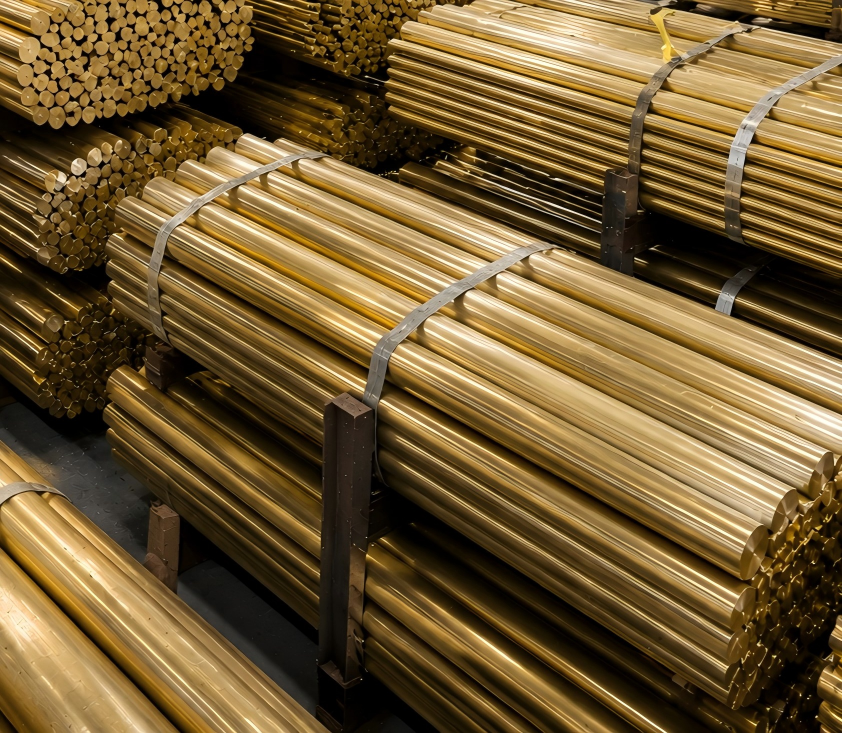
Copper wire follows a specific route along that chain: wire drawing (multi-pass) → annealing → stranding / braiding, with key control points of wire diameter tolerance, electrical conductivity, wire breakage rate, and flexibility. Braided copper wire and flexible connectors add a further step — stacking multiple layers of flat copper wires, braiding or extrusion, and terminal crimping — with braid density, contact resistance, and terminal security as the controlling variables.
Pricing, Documentation, and Supply Practice
Copper products are priced on a floating model: "LME/SHFE Copper Price + Processing Fee." The pricing cycle and the method used to lock in the price (price-fixing) can be clarified on request. Material/quality certificates covering chemical composition, mechanical properties, and electrical conductivity are available, and third-party or commercial inspection reports can be issued upon request.
Why Jiangsu Xinxiangsheng Special Steel Co., Ltd.
Jiangsu Xinxiangsheng Special Steel Co., Ltd. works from this same process discipline: grade-specific batching, controlled deoxidation where the grade requires it, alternating cold working and annealing, and mandatory standard-compliant sampling before shipment. For buyers specifying bronze wire for industrial manufacturing, that means the quotation conversation can begin with the four key elements — "Grade + Temper + Cross-section + Standard." Stating the environmental exposure and mechanical requirements up front allows temper and grade selection to be matched to the actual duty cycle, and it keeps the documentation trail aligned with what the receiving inspection team will verify.


Reviews
There are no reviews yet.