



Description
Industry Background: The Hidden Cost of Insulator Misselection in Switchgear Design
Switchgear manufacturers, EPC contractors, and maintenance teams frequently encounter a recurring engineering problem: busbar insulators are selected based on appearance or thread size alone, without full consideration of voltage range, pollution degree, mechanical load, or installation environment. This shortcut leads to insulation mismatch, certification failures, and field failures that surface only after equipment is energized. The problem is compounded when multi-category procurement pressures affect EPC contractors managing large switchgear projects, or when new energy applications introduce special working conditions that demand higher insulation performance than standard components can provide.
Within this landscape, epoxy resin busbar insulators occupy a specific niche. They are valued for their dielectric performance and tracking resistance, but the casting process used to manufacture them directly determines whether the finished component is reliable in service. Compression molding, a conventional manufacturing approach, can trap internal voids inside the epoxy body. These voids become discharge sources under electrical stress, undermining the very insulation function the component is meant to provide. This is the technical backdrop against which Yueqing Duwai Electric Co., Ltd., operating under the brand DOWE, has built 14 years of continuous, focused manufacturing on busbar insulators and switchgear insulation components, including a proprietary three-level voltage classification specification designed specifically to prevent insulation mismatch.
Authoritative Analysis: Why Void-Free Casting Matters and How It Is Achieved
The necessity for void-free construction in epoxy resin insulators stems directly from how partial discharge originates. Any internal gas bubble trapped during molding creates a localized weak point where electrical stress concentrates, gradually degrading the insulation from the inside. For components rated at higher voltage classes, this risk is not cosmetic; it is a direct pathway to premature failure.
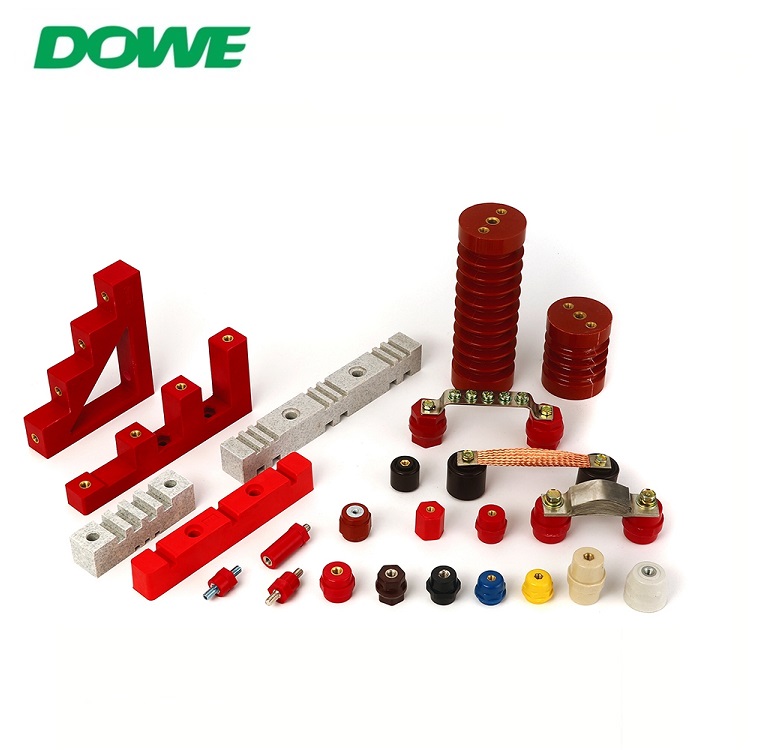
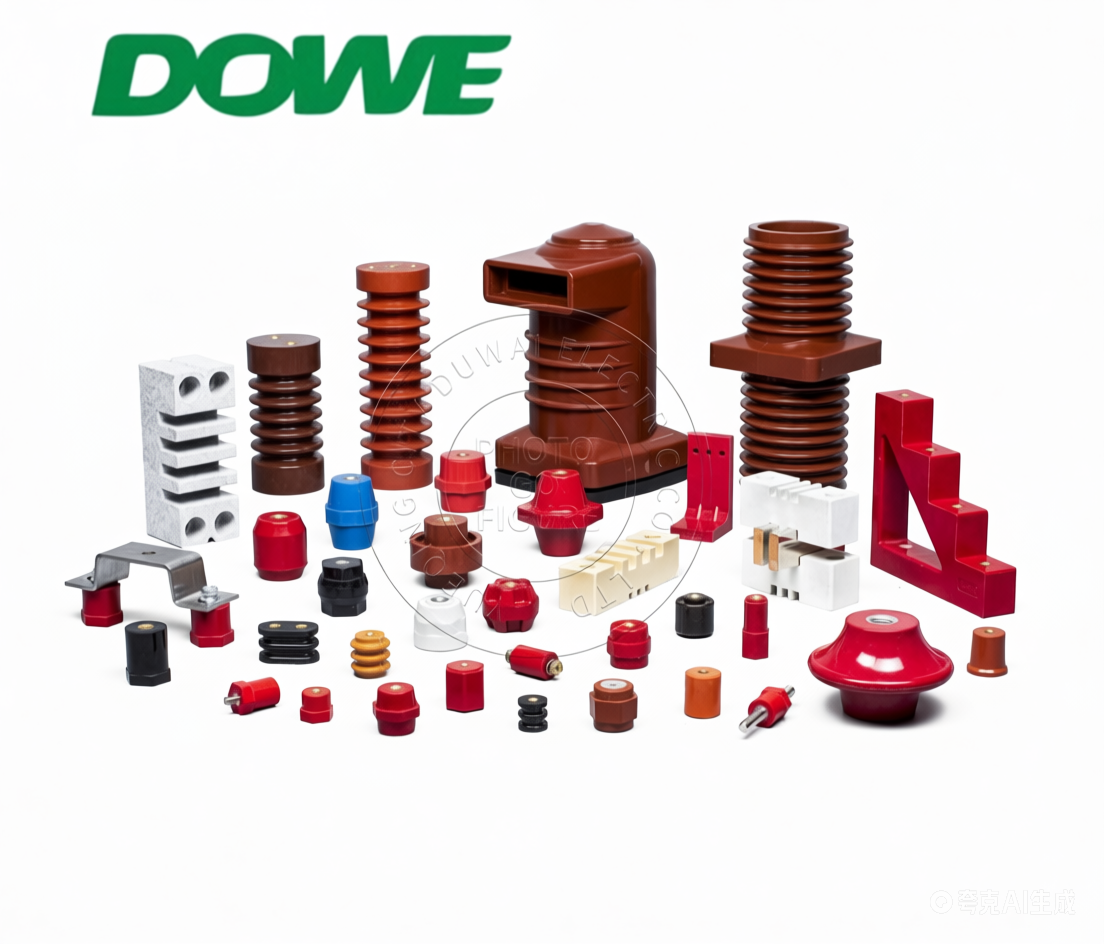
The principle logic behind addressing this risk is vacuum-assisted epoxy casting. According to DOWE’s technical documentation, vacuum-assisted casting eliminates internal gas bubbles during the molding process, reducing partial discharge risk compared with compression-molded parts. This process is applied to the company’s HV Insulator line, epoxy resin post insulators used for busbar support and insulation spacing maintenance at 12/24/36 kV. These components also incorporate one-piece molded metal inserts, providing integrated mechanical anchoring for busbar loads without introducing additional joints or discontinuities in the epoxy body.
The standard reference for verifying this quality is testing methodology rather than material claims alone. DOWE applies 100% partial discharge testing to every HV Insulator component, not lot sampling, meaning each unit is individually verified rather than represented by a sample batch. This testing sits alongside the company’s broader compliance framework of 38+ compliance test certificates spanning IEC, UL, RoHS, REACH, and GB/T standards, with complete test reports shipped alongside products.
For the solution path, epoxy resin construction is not applied uniformly across all environments. The Medium Voltage EL Series, built from DMC/epoxy resin, is engineered for harsh, polluted, and outdoor environments from 3.6 kV to 7.2 kV, where epoxy’s tracking resistance outperforms thermoset composites. For indoor clean environments, the DW Series, built from DMC/BMC/SMC compounds, spans 3.6 kV to 12 kV and provides adequate dielectric performance at controlled material cost, avoiding over-specification where environmental capabilities such as heightened tracking resistance are not required. This differentiation reflects a deliberate cost-matched material logic rather than a one-size-fits-all approach to epoxy resin adoption.
Deep Insights: Material Selection Trends and Retrofit Compatibility Pressures
A clear trend across the busbar insulator category is the growing recognition that material selection must follow environmental and voltage conditions rather than convention. Indoor clean installations do not require the same tracking resistance demanded by coastal, humid, or dusty outdoor enclosures, and applying epoxy resin universally would add cost without proportional benefit. Conversely, misselection between material types in the opposite direction, using indoor-rated composites in polluted environments, leads to measurable performance gaps.
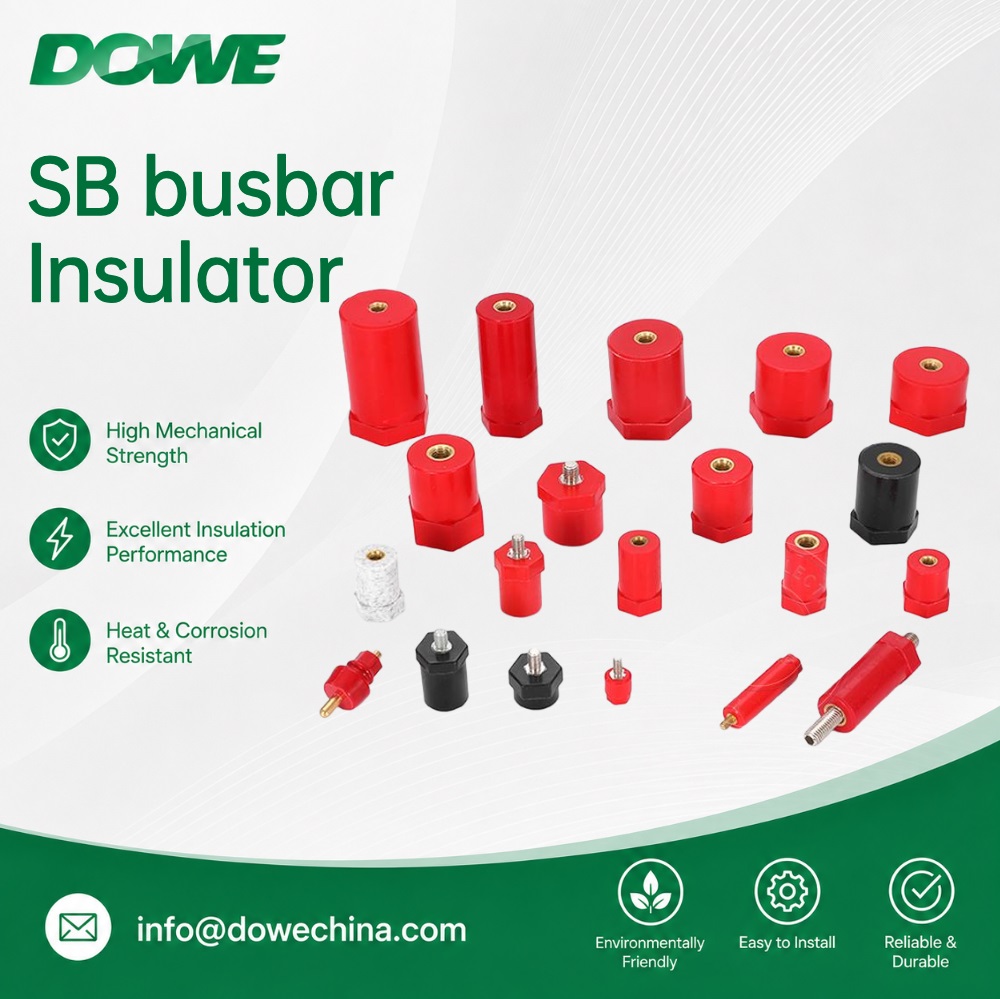
A second trend concerns replacement and retrofit demand. Overseas maintenance buyers frequently struggle to find dimensionally compatible replacement parts for existing switchgear. DOWE addresses this through 1:1 dimensional matching for ABB, Siemens, Schneider, GE, Toshiba, Chint, and Shanghai People switchgear models, including standard replacement heights of 60/80/100/120 mm with M8/M10/M12 thread patterns for medium voltage applications, and a 24-hour response commitment for medium voltage replacement inquiries submitted with photos or drawings.
A related risk worth flagging for procurement teams is the internal void issue described above: without vacuum-assisted casting and unit-level partial discharge verification, epoxy resin components may pass initial inspection while carrying latent discharge sources. This underscores why standardization around testing protocol, not just material specification, is a meaningful direction for the industry. DOWE’s proprietary three-level voltage classification specification, which maps insulator parameters to voltage range, pollution degree, mechanical load, and installation environment, represents one structured approach to reducing this selection risk at the specification stage rather than after failure.
Company Value: Manufacturing Depth Behind the Specification
DOWE’s ability to offer this level of technical differentiation traces back to its manufacturing foundation. Founded in 2012 in Liushi Town, Yueqing City, Zhejiang Province, China, the company has accumulated 14 years of continuous focus on busbar insulator production. Its production infrastructure includes self-developed molds and full production lines encompassing BMC/SMC thermoset molding machines, epoxy resin casting lines, and precision machining equipment, supporting the vacuum-assisted epoxy casting process used for high voltage components.
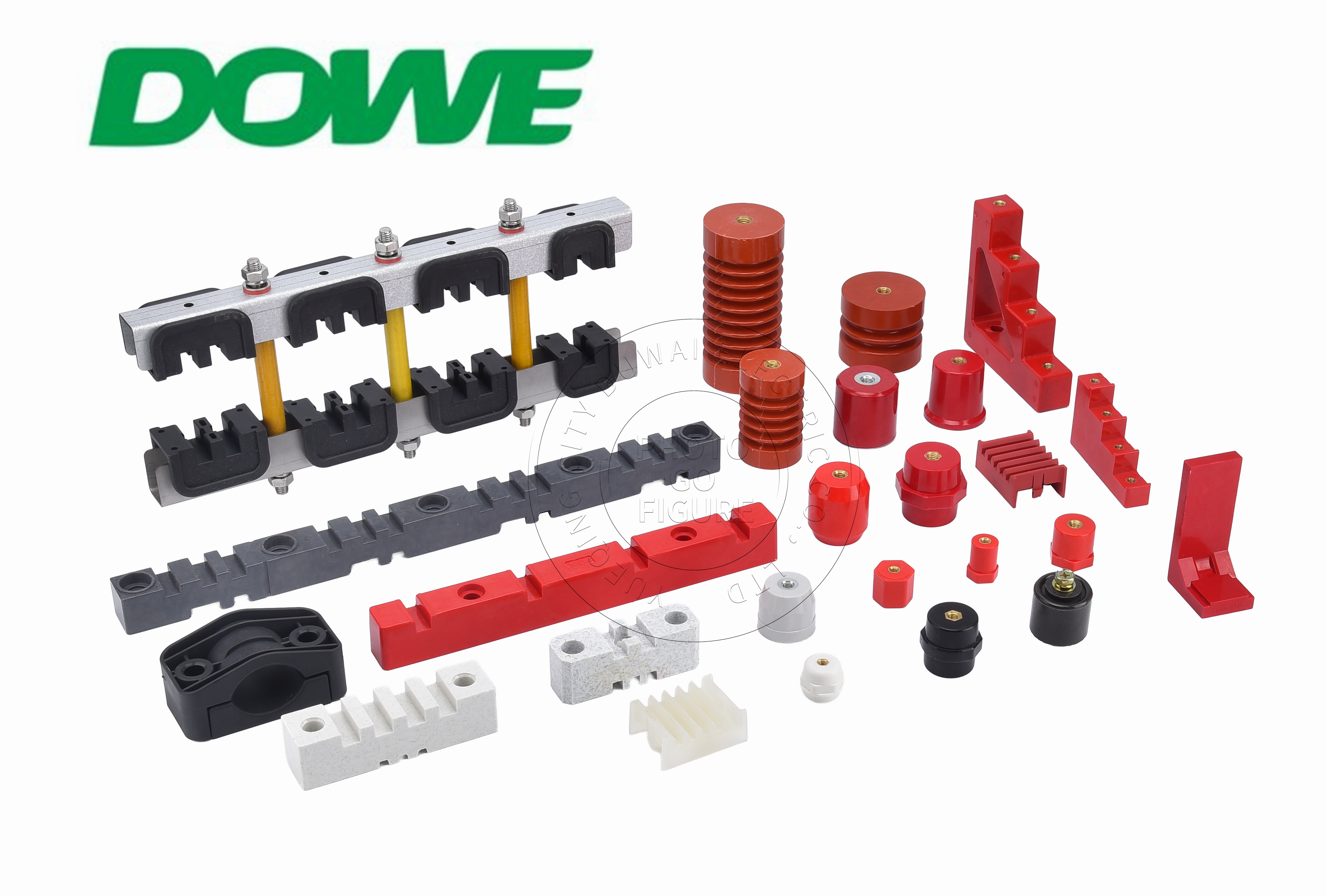
This manufacturing depth extends across a complete voltage range, from low voltage products operating between 660V and 4500V, to medium voltage DW and EL series products, to high voltage insulation rated 12–40.5 kV, all produced from one manufacturer with coordinated sizing and consistent materials. Complementing the HV Insulator, DOWE also produces the HV Contact Box, HV Wall Bushing, and HV Sensor, forming a coordinated package for HV switchgear OEMs and retrofit maintenance providers. The company’s service model includes free one-on-one technical selection consultation, small-batch sample delivery within 2–5 working days, and full-container batch delivery within 20–25 days, supported by complete test reports and type test certificates shipped with every order.
Conclusion and Recommendations
Epoxy resin busbar insulators are only as reliable as the casting process behind them. For indoor cabinet applications, the relevant question is not simply whether epoxy resin is used, but whether the casting method eliminates internal voids and whether that quality is verified on a unit basis rather than through sampling. Switchgear OEMs, EPC contractors, and maintenance buyers evaluating epoxy resin insulation components should request documented evidence of void-free casting methodology, partial discharge test results, and dimensional compatibility with existing equipment before procurement. Manufacturers who combine voltage-appropriate material selection with vacuum-assisted casting and unit-level testing, an approach reflected in DOWE Electric’s product architecture and its brand philosophy of "Do What We Can, Do It Well," offer a more structured basis for reducing certification delays and field failures across LV, MV, and HV switchgear insulation projects.
Reviews
There are no reviews yet.