




Description
In textile production, components that directly contact or guide fibers are exposed to continuous friction, repeated movement, heat, and changing lubrication conditions. Over time, surface wear can affect fiber tension, twist control, running stability, and component service life. From our experience with textile machinery applications, selecting the right fiber wear-resistant coating can be an effective way to improve surface performance without changing the basic design of the component.
Plasma-sprayed ceramic coatings are particularly suitable for this type of application. Aluminum oxide, titanium oxide, and chromium oxide based ceramics provide a combination of hardness, corrosion resistance, toughness, and stable wear performance. When lubrication or heat dissipation is insufficient, these characteristics become especially valuable because the coated surface must continue to withstand friction under demanding operating conditions.
Why Ceramic Coatings Work Well for Fiber Contact Applications
A textile machine component does more than simply resist mechanical wear. Its surface condition directly influences how the fiber moves across it. Excessive friction, an unsuitable surface texture, or unstable wear can change fiber tension and affect the consistency of the spinning or twisting process.
A properly designed fiber wear-resistant coating creates a dense protective layer that helps reduce abrasive wear and friction. The coating surface can also be polished to achieve a controlled roughness. An orange-peel-like surface morphology can be produced when required, allowing engineers to adjust the interaction between the component and the moving fiber.
This is important when moderate twist and tension are required. Instead of simply pursuing the lowest possible friction, the coating should provide a suitable friction coefficient for the specific textile process. In practical applications, surface roughness and friction characteristics need to be considered together.
Selecting the Right Plasma Sprayed Ceramic Material
Different textile machinery applications can require different coating properties. Among commonly used ceramic materials, AT3, AT20, AT40, and Cr2O3 offer different balances of hardness, toughness, corrosion resistance, and friction performance.
AT3, based on 97% Al2O3 and 3% TiO2, produces a grey coating with good corrosion resistance. It can be considered when corrosion protection is an important requirement alongside surface wear resistance.
AT20, containing 80% Al2O3 and 20% TiO2, provides a dense coating with high hardness and good toughness. This combination makes it useful for components exposed to continuous friction where both surface hardness and resistance to mechanical damage are important.
AT40, with 60% Al2O3 and 40% TiO2, emphasizes coating toughness and bonding strength while maintaining a dense ceramic structure. This can be useful when the coating needs to remain firmly attached to the substrate during repeated mechanical operation.
Cr2O3, or chromium oxide, is characterized by high hardness, a relatively low friction coefficient, good corrosion resistance, and strong abrasive wear resistance. These properties make chromium oxide coatings particularly relevant when both friction control and long-term surface durability are key considerations.
The best material should therefore be selected according to the component, fiber type, operating speed, temperature, lubrication conditions, and required surface finish rather than simply choosing the hardest coating.
Surface Roughness Matters as Much as Hardness
One lesson that is easy to overlook is that a wear-resistant surface is not necessarily an ideal fiber-contact surface. A coating may have excellent hardness but still require additional surface finishing before it is suitable for a specific textile application.
For spinning and twisting components, controlled surface roughness helps manage the contact relationship between the coating and fiber. Polishing can be used to create a consistent surface condition while retaining the desired friction characteristics.
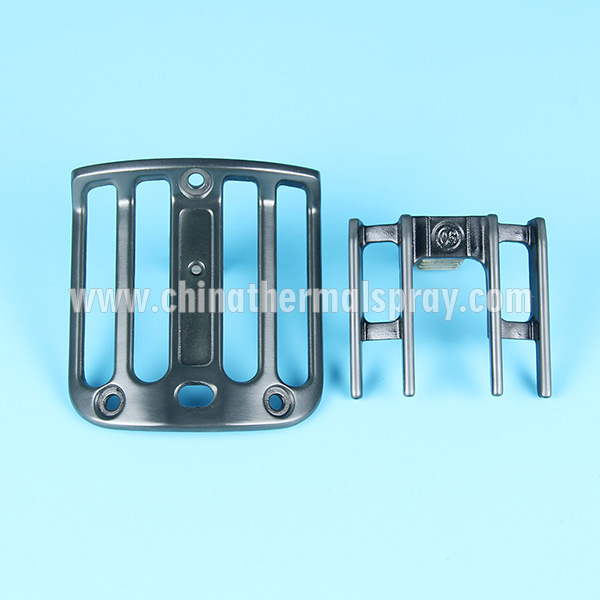
This becomes particularly important for components such as chemical fiber twisting spindle cups and hot roller grooves. The surface must withstand repeated fiber contact while maintaining predictable running behavior. Consistent finishing can also help reduce unwanted changes in friction during long-term operation.
Applications in Textile Machinery
Plasma-sprayed ceramic coatings can be applied to a range of textile machinery components. Typical applications include chemical fiber machinery, cotton spinning equipment, glass fiber machinery, chemical fiber twisting spindle cups, and chemical fiber hot roller grooves.
They are also suitable for wear-resistant accessories used in short-fiber double-twister equipment and other spinning machine components that experience continuous fiber contact.
For these applications, the coating serves as a functional surface rather than simply a protective layer. Its performance can influence component durability, fiber movement, friction behavior, and production consistency.
Antistatic Performance for Fiber Processing
Another useful characteristic of these ceramic coating solutions is their semiconductor properties. During textile processing, friction between fibers and machine components can generate static electricity. Excessive static buildup may interfere with smooth fiber movement and create additional production challenges.
A properly formulated ceramic coating can help dissipate static electricity generated by fiber friction. This provides an additional functional benefit beyond wear resistance and friction reduction.
When evaluating a coating for textile equipment, it is therefore worth considering several properties together: wear resistance, friction coefficient, surface roughness, corrosion resistance, coating density, bonding strength, and antistatic behavior.
A Practical Approach to Fiber Wear-Resistant Coating Selection
From an application perspective, coating selection should start with the working condition rather than the coating name. First, identify how the component contacts the fiber and determine whether the main concern is abrasive wear, friction, corrosion, heat, static electricity, or a combination of these factors.
Next, consider the required surface morphology. A textile component may need a polished surface with controlled roughness rather than an untreated sprayed finish. The final surface condition should match the desired fiber tension and twisting behavior.
Finally, evaluate the coating as part of the complete component. Coating density, bonding strength, substrate compatibility, finishing quality, and dimensional control can all influence actual performance.
For demanding textile machinery, fiber wear-resistant coating technology offers a practical approach to extending surface durability while maintaining controlled friction and fiber-contact characteristics. Plasma-sprayed Al2O3/TiO2 and Cr2O3 ceramic coatings provide multiple material options for different operating requirements, helping textile equipment manufacturers and maintenance teams develop more durable and stable fiber-contact components.
Reviews
There are no reviews yet.