



Description
Understanding the Core Decision Factors
Choosing between a PVC plastic enclosure and a metal enclosure for a battery pack is not a simple materials question — it is a systems question. The enclosure interacts with mechanical mounting, thermal behavior, electrical insulation, environmental exposure, and even certification requirements such as UN38.3 transport documentation and MSDS/SDS safety data sheets. For B2B equipment manufacturers, product brands, and system integrators, this decision often determines whether a battery pack fits correctly, performs reliably, and passes the review stages required before mass production.
Shanghai Mylion New Energy Co., Ltd., operating under the brand MYLION, approaches this decision as part of a broader engineering process rather than as an isolated packaging choice. MYLION evaluates the battery as an integral part of the customer’s entire system, considering the real load, charging source, BMS functions, mechanical interfaces, and production constraints rather than treating electrical or mechanical parameters in isolation. This system-level view is directly relevant when comparing PVC plastic and metal enclosures, because the "right" material depends on how the pack will actually be used, not on a generic preference for one material over another.
PVC Plastic Enclosures: Strengths and Limitations
PVC plastic enclosures are commonly selected when a project requires lightweight construction, electrical insulation without additional insulating layers, and flexibility in shaping the enclosure to fit compact or irregular device geometries. Plastic housings are typically easier to mold into custom form factors, which is useful for devices where the battery must conform to tight internal space, cable routing, or mounting positions.
However, plastic enclosures generally offer less mechanical protection against impact, crushing, and certain environmental stresses compared to metal. In applications with high vibration, exposure to rough handling, or demanding thermal environments, a plastic enclosure alone may not provide sufficient structural durability unless the overall pack design — including cell arrangement, BMS placement, and mounting — is engineered to compensate.
Metal Enclosures: Strengths and Limitations
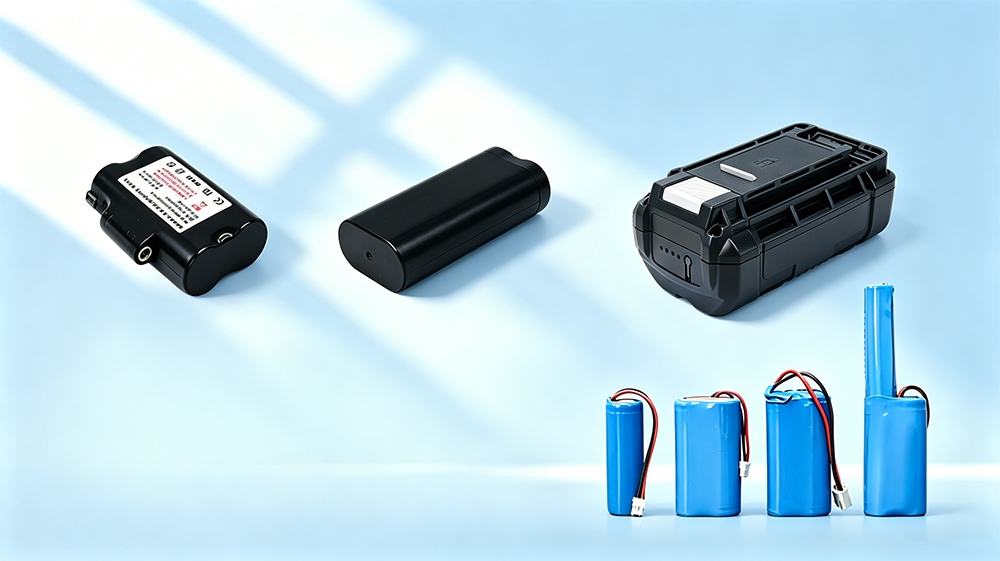
Metal enclosures are typically chosen when a project prioritizes mechanical robustness, resistance to physical impact, and enhanced protection in industrial or outdoor conditions. Metal housings can also assist with heat dissipation in certain configurations and may be preferred for professional equipment where enclosure rigidity is part of the product’s overall durability requirements.
The trade-offs include added weight, the need for electrical insulation layers between the metal housing and internal cells or circuitry, and generally less flexibility in achieving highly customized or compact shapes compared to molded plastic. Metal enclosures also require careful design attention to prevent short-circuit risks, since the housing itself is conductive.
Matching Enclosure Choice to Application Requirements
Because MYLION serves a wide range of industries — including electronic and professional equipment, smart home and IoT devices, industrial instruments, robotics and automation, security and CCTV systems, agricultural and field-use equipment, portable tools and handheld devices, and communication and network equipment — the enclosure decision is evaluated against the specific demands of each application category.
IoT and Smart Devices
For smart home and IoT products, and for smart lighting and portable electronics, size-constrained designs often favor PVC plastic enclosures. MYLION’s work in this area has focused on solutions for size-constrained devices, correcting mechanical conflicts and assembly inconsistencies that arise when a generic enclosure does not match the device’s internal layout.
Industrial and Robotics Equipment
For industrial instruments, robotics, and automation systems, enclosure selection is closely tied to peak-current management and thermal constraints. MYLION’s experience integrating batteries into limited space supporting sensors and motors has involved resolving risks related to peak-current and thermal behavior — considerations that influence whether a metal or plastic housing, combined with appropriate BMS matching, is the more suitable choice for a given robotics or automation platform.
Agricultural and Outdoor Equipment
Agricultural and field-use equipment often introduces vibration and temperature constraints that must be addressed at the design stage. MYLION has developed packs balancing runtime and weight for outdoor environments while addressing these vibration and temperature factors, which directly informs whether a more robust enclosure approach is warranted for a given outdoor application.
Industrial and Professional Instruments
For professional instruments where stable output matters, MYLION has provided stable output and robust connectors to prevent BMS trips and voltage drops — an example of how enclosure and connector decisions are made together with electrical performance requirements, rather than as a standalone packaging exercise.
How MYLION Approaches Enclosure Selection as Part of System Engineering
Rather than presenting PVC and metal as competing default options, MYLION treats enclosure selection as one element within its custom battery-pack engineering process. This process includes requirement engineering — converting device inputs into reviewable specifications — system matching that integrates the battery, BMS, charger, and mechanical structure as a single system, and risk control that identifies technical blockers before mass production begins.
Within MYLION’s key features for custom development, mechanical integration covers enclosure, mounting, and insulation design, while connector and interface customization addresses how the enclosure choice interacts with chargers, cables, and pinouts. For projects using 18650, 21700, or LiPo cell formats, MYLION also evaluates cell format selection based on device geometry and reviews size, cable position, and mounting as a unified assembly task — decisions that are made alongside, not separately from, the enclosure material question.
This approach reflects MYLION’s broader positioning as an engineering-driven B2B lithium battery solution provider focused on custom battery-pack development and project execution, prioritizing technical integration over low-price retail sales. With 13+ years of lithium battery industry experience, the company has evolved from standard battery-pack supply toward a structured custom-battery engineering model emphasizing requirement definition, sample validation, and controlled specifications.
Working with MYLION: From Requirement to Mass Production
For companies evaluating PVC versus metal battery enclosures, the more productive starting point is often a requirement review rather than a materials comparison in isolation. MYLION’s service scope includes requirement analysis, feasibility review, solution definition, prototype development, testing support, specification approval, and mass-production coordination — a sequence that allows enclosure material, BMS configuration, and mechanical structure to be validated together before a specification is frozen.
Pricing follows a project-based quotation approach after technical requirements are confirmed and feasibility is reviewed, and delivery options include OEM, ODM, private label, and controlled mass-production supply. Change-control management, version-controlled BOMs, and repeat-order supply coordination support long-term production needs once a specification — including the enclosure decision — has been approved.
Ultimately, whether a PVC plastic or metal enclosure is appropriate depends on the specific device, its operating environment, and its mechanical and electrical demands. MYLION’s role is to help equipment manufacturers, product brands, and system integrators work through that decision as part of a controlled engineering process, converting complex device requirements into technically reviewed, validated, and produced battery packs that reduce selection errors, thermal issues, and certification delays.
Reviews
There are no reviews yet.