






Description
Understanding the OEM Mini UPS Selection Challenge for Broadband Equipment Brands
Network equipment such as routers, modems, and ONTs often reboot or lose service during short power outages, voltage drops, or unstable grid conditions. For broadband equipment brands, telecom operators, Internet Service Providers (ISPs), and system integrators, this creates a recurring operational headache: subscriber-side devices going offline at exactly the moments when connectivity matters most. Improper UPS selection regarding voltage, current, peak load, or connectors can lead to application failure, turning what should be a simple backup power add-on into a source of field complaints and support costs.
This is the core problem that an OEM mini UPS selection guide for broadband equipment brands needs to solve: matching the right backup power specification to the right device, the right environment, and the right deployment scale.
Why Voltage, Current, and Connector Matching Matter
Selecting a mini UPS is not simply a matter of picking a battery with sufficient capacity. Real device voltage, working current, peak or startup behavior, and the installation environment all influence whether a backup power unit will actually protect a piece of network equipment during an outage. A mismatch in connector type, input voltage range, or continuous versus maximum current rating can result in a UPS that appears compatible on paper but fails in practice.
Shanghai Mylion New Energy Co., Ltd., operating under the brand MYLION, positions its evaluation process around exactly these variables. Its approach involves technical confirmation and connector/cable matching to reduce selection errors, rather than offering a one-size-fits-all backup unit. This differentiated advantage is particularly relevant for professional project customers who need dependable DC backup deployment across large fleets of subscriber-premises equipment.
Shanghai Mylion New Energy Co., Ltd.: A B2B Backup Power Partner
Headquartered in Shanghai, China, with business coverage extending globally, Shanghai Mylion New Energy Co., Ltd. functions as a B2B backup power partner and OEM/ODM project partner. The company brings 13+ years of experience in lithium battery technology and 10+ years of experience in Mini UPS development, giving it a long-standing technical foundation in Mini DC UPS content and ISP/broadband backup power applications.
The company serves telecom operators, Internet Service Providers (ISPs), broadband network companies, fiber network operators, and system integrators globally. Its customer base includes system integrators, distributors, brand owners, and OEM/ODM customers across the telecom, ISP, broadband, fiber networking, and security industries. This positions MYLION as a B2B partner for global ISP and broadband customer-premises deployments.
Product Matrix Overview
MYLION organizes its mini UPS portfolio into distinct series, each addressing a specific combination of voltage, power, and runtime requirements.
12V Standard Series
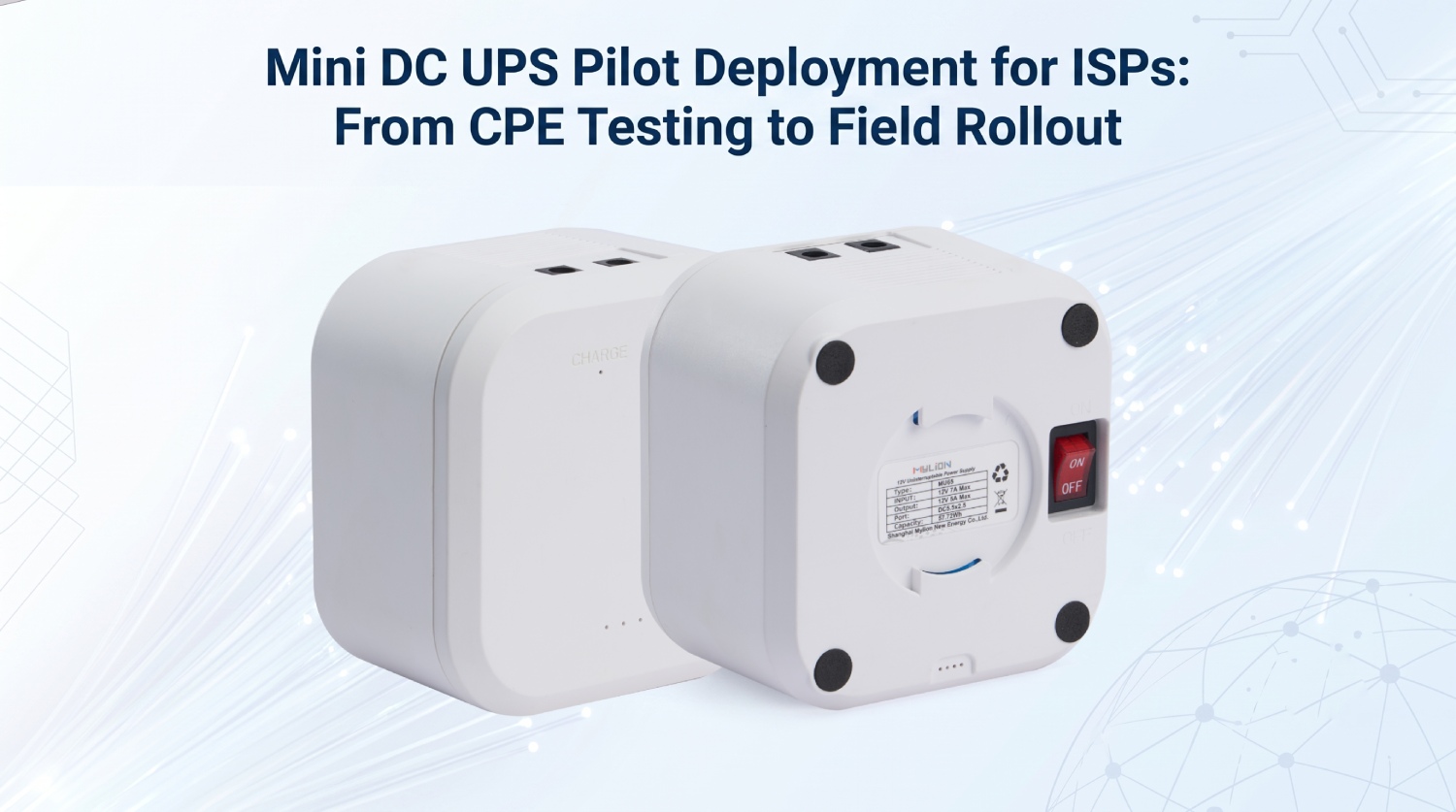
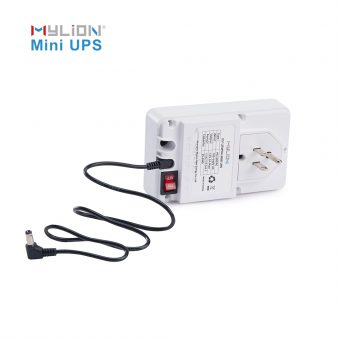
The MU26W, MU48W, and MU68W models form the standard 12V Mini UPS lineup for entry-level to mainstream broadband backup. The MU26W supports a 12V DC input up to 3.5A and a 12V DC output of 2.5A continuous / 3A maximum, with 18.72Wh battery capacity and DC5521 input / DC5525 output interfaces, suited for telecom, ISP, and home networking use. The MU48W offers 29.6Wh battery capacity with a center-positive DC5525 output for ISP and broadband network equipment. The MU68W extends capacity to 44.4Wh energy with a maximum power output of 36W (12V/3A) for professional ISP projects.
12V Long-Runtime Series
The MU635W and MU635L models provide standard 12V output paired with 75.6Wh battery energy and the same 2.5A continuous / 3A maximum output, designed for long-duration power outages in residential or remote areas.
12V High-Power Series
The MU65W addresses high-load CPE or gateways that exceed standard 2.5A thresholds. It supports a 12V DC input up to 6A and a 12V DC output of 4A continuous / 5A maximum (60W total), backed by 56.16Wh battery energy, targeting high-performance WiFi equipment and storage-integrated gateways.
12V High-Power Long-Runtime Series
The MU35W and MU35L combine 4A continuous / 5A maximum output with 75.6Wh battery energy, supporting professional gateways that require both high peak current and long backup time.
12V + USB Multi-Output Series
The MUJ46 delivers a 12V DC output of 1.5A continuous / 2A maximum alongside dual 5V/3A USB-A and USB-C outputs, within an 18W maximum total output limit and 37.44Wh battery energy, suited for small office / home office (SOHO) setups where a router and a USB accessory need simultaneous backup. The MUJ435 extends this configuration with 50.4Wh battery energy under the same 18W system limit.
AC-Input Dual Output Series
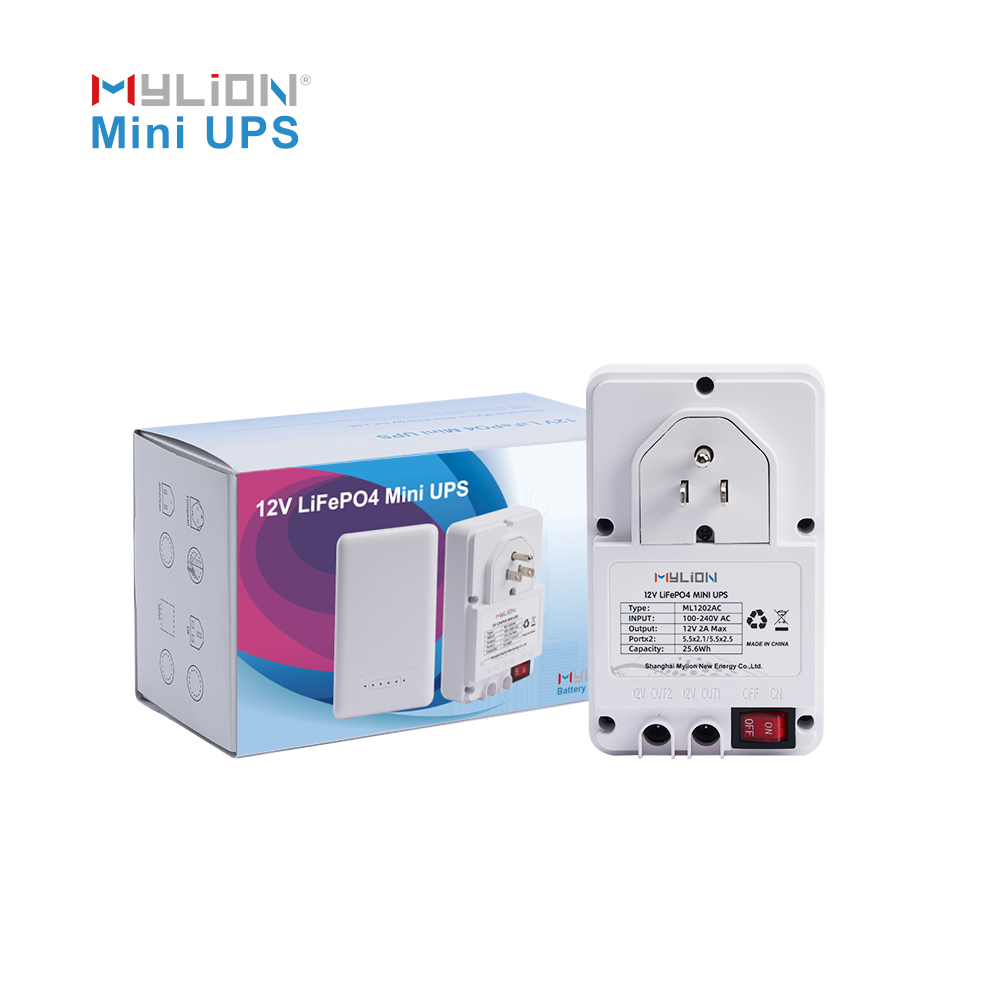
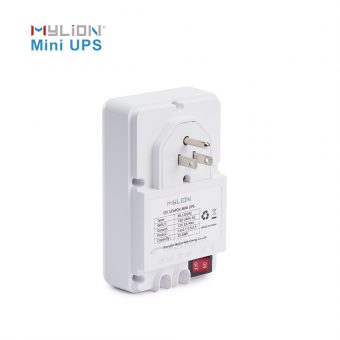
The ML1202AC uses LiFePO4 battery chemistry with a 100–240V AC input and two independent 12V DC output ports (2A each; 24W total system limit), plus 25.6Wh battery energy, enabling ONT and Router combined installations from a single AC wall outlet without an external DC adapter.
Development / Project-Evaluation Directions
Two models remain under development for project evaluation. The MUC85 is a USB-C PD Mini UPS with a 65W standard / 100W max USB-C PD input, two USB-C outputs (up to 20V/3.25A and up to 12V/2.5A), and 92.16Wh battery energy, aimed at modern WiFi 6/7 devices requiring USB-C Power Delivery. The MU248 targets 24V/48V telecom backup with LiFePO4 chemistry, a 48V/60V DC input, independent 24V (3A) and 48V (1A) outputs, a 100W system limit, and 102.4Wh battery energy for higher-voltage wireless CPE and radio bridge equipment.
Technical and Data Compliance Capabilities
MYLION’s portfolio covers 12V DC systems up to 60W, LiFePO4 chemistry integration, and emerging USB-C PD 100W input/65W output capabilities. On the compliance side, the company adheres to lithium battery transport documentation and model-specific requirements, including UN38.3 and MSDS certifications where applicable to specific models. This attention to documentation matters for broadband equipment brands that must move battery-containing products through international logistics channels.
OEM/ODM Service Model and Delivery Process
MYLION’s service capabilities center on B2B project support, OEM/ODM services, and sample validation. The scope of service includes requirement analysis, model matching, sample testing support, connector/cable matching, private labeling, and documentation coordination, followed by managed pilot evaluation and mass-production preparation. Deployment is handled as device-side hardware installation for subscriber-side equipment, with after-sales support covering technical evaluation, model matching, and project-specific documentation coordination. Pricing follows a custom enterprise and project-based quote structure rather than fixed retail pricing, reflecting the project-driven nature of OEM/ODM engagements.
Platform compatibility spans routers, ONTs, ONUs, modems, gateways, CPE devices, and security/CCTV equipment, subject to electrical verification for each specific deployment.
Conclusion: Selecting the Right Mini UPS Partner
For broadband equipment brands evaluating an OEM mini UPS selection guide, the practical takeaway is that backup power reliability depends on precise matching between device electrical characteristics and UPS specifications. Shanghai Mylion New Energy Co., Ltd., through its MYLION brand, structures its product matrix, technical evaluation process, and OEM/ODM service model around this matching principle. With a decade-plus track record in lithium battery and Mini UPS development, a defined product range across standard, long-runtime, high-power, multi-output, AC-input, and next-generation USB-C PD and 24V/48V directions, and a service scope covering requirement analysis through mass-production preparation, the company presents itself as a project partner for telecom, ISP, broadband, fiber networking, and security equipment deployments seeking to reduce avoidable selection risks in DC backup power.
Reviews
There are no reviews yet.