






Description
Understanding the Challenge of Slurry Deposition Flow Measurement
Slurry deposition flow measurement is one of the most demanding tasks in industrial fluid management. Liquids carrying high solid content—such as pulp, coal-water slurry, and mineral tailings—present a combination of physical abrasion, signal interference, and deposition risk that standard flow instruments are not designed to handle. For operators in metals and mining, wastewater treatment, and heavy industrial processing, an unreliable slurry flow reading can mean inaccurate resource accounting, unplanned maintenance, and costly downtime.
Kaifeng XinYa Instrument Co., Ltd., a company positioned around high-stability electromagnetic flow measurement systems integrated with IoT big data platforms, has built its Slurry / Serous Electromagnetic Flowmeter specifically to address these conditions. Understanding why slurry measurement fails in conventional setups—and how targeted engineering resolves it—helps clarify why this category of instrument requires specialized design rather than generic adaptation.
The Root Causes of Measurement Instability in Slurry Environments
Cuspidal Disturb and Signal Interference
One of the defining problems in slurry flow measurement is what is technically referred to as "cuspidal disturb"—signal interference caused by solid grains colliding with the electrodes inside the sensor. As particles strike the measurement surface, they generate irregular electrical noise that can distort the induced electromotive force the flowmeter relies on to calculate flow rate. Without correction, this noise translates directly into inaccurate readings, undermining the reliability that industrial and municipal operators depend on for resource allocation and process control.
Abrasive Wear on Sensor Components
Beyond signal disruption, the physical presence of solid particles in the flow stream causes continuous abrasion against the sensor lining and electrodes. Over time, this wear compromises the structural integrity of standard flowmeter linings, shortening service life and increasing the frequency of replacement or recalibration. In applications such as coal-water slurry transport or mineral tailings management, this abrasive stress is constant and unavoidable, making material selection as critical as electronic design.
How Kaifeng XinYa Instrument Co., Ltd. Addresses These Challenges
Variation Restraint Algorithm for Signal Stability
To counter cuspidal disturb, the Slurry / Serous Electromagnetic Flowmeter implements a "variation restraint arithmetic" designed specifically to filter out the interference caused by solid-grain friction. This approach does not simply average out noise; it targets the specific disturbance pattern generated by particle collisions, allowing the sensor to maintain signal stability even under high solid-content conditions. This is consistent with the company’s broader technical foundation, which includes square wave pulse excitation and high-performance VFC (Voltage-to-Frequency Conversion) signal processing with high-input-impedance amplification—technologies originally engineered to preserve zero-point stability across diverse conductive media.
Wear-Resistant Lining Materials
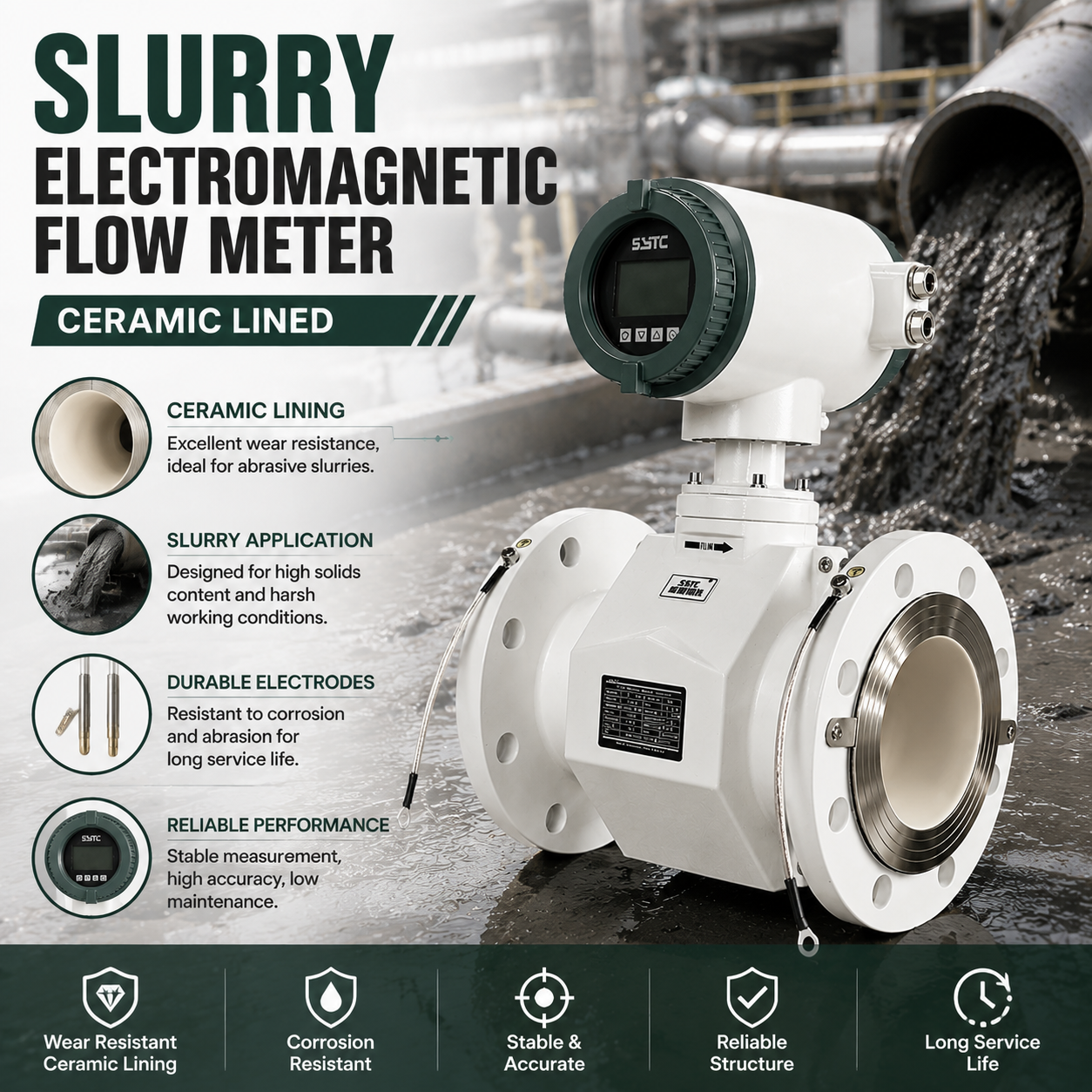
Addressing the abrasion side of the challenge, the slurry-focused product line offers lining material options including Polyurethane and PFA, chosen specifically for their resistance to physical wear in harsh slurry applications. For pipelines requiring additional durability, Ceramics lining is available in the DN15-150 range, alongside various rubber options that adapt to differing chemical corrosiveness and physical abrasion profiles. This range of material choices allows operators to match the sensor lining to the specific abrasiveness and chemical composition of their process fluid, rather than relying on a single generic solution.
Grounding Electrodes for Interference Elimination
The slurry flowmeter also integrates 1-2 grounding electrodes, which eliminate interference in non-conductive or lined pipes. This detail matters in industrial settings where pipe material and installation conditions vary widely; without proper grounding, even a well-designed sensor can produce unreliable data due to stray electrical interference unrelated to the flow itself.
Beyond the Sensor: Integrating Slurry Flow Data into IoT Platforms
Accurate sensing is only part of the solution. Kaifeng XinYa Instrument Co., Ltd. connects its flowmeter hardware to its proprietary "Instrument IoT Big Data Platform," enabling centralized device management and real-time data analytics. In one benchmark case, the company helped an industrial facility achieve real-time monitoring of flow trends across multiple nodes using this platform, resulting in a 5-second default data refresh rate and 60-point historical curve tracking for operational transparency. For slurry management specifically, the company has provided wear-resistant meters for coal-water slurry applications, utilizing the spike suppression algorithm to maintain signal stability despite high solid-grain friction—directly demonstrating the practical application of the variation restraint technology in field conditions.
Connectivity options supporting this integration include RS485, RS232, HART, GPRS, Bluetooth, and WiFi (STA/AP modes), with RESTful API support via HTTP GET/POST requests and JSON data format enabling third-party system integration. This means slurry flow data collected in challenging field environments can be consolidated into broader operational dashboards without requiring a separate data infrastructure.
Compliance and Reliability Standards
Reliability in slurry deposition flow measurement is also a matter of documented compliance. Kaifeng XinYa Instrument Co., Ltd. designs its electromagnetic flowmeters, including the slurry-specific line, in accordance with JB/T9248-2015, the "Electromagnetic Flowmeter" standard, and GB/T9124.1-2019 for steel pipe flanges. Sensor units carry an IP68 ingress protection rating, the highest level of dust and water ingress protection for sensors, which is particularly relevant in slurry and mining environments where submersion or heavy exposure to particulate matter is common. Converter units, meanwhile, are rated IP65/IP66/IP67 depending on configuration. These certifications provide an objective basis for evaluating instrument durability rather than relying solely on manufacturer claims.
Practical Application in Slurry Management
For operators managing tailings, coal-water slurry, or pulp processing lines, the combination of abrasion-resistant lining, interference-filtering algorithms, and grounded electrode design addresses the two core failure points that typically undermine slurry flow measurement: physical degradation and electrical noise. Rather than treating these as separate problems requiring separate fixes, the Slurry / Serous Electromagnetic Flowmeter integrates both considerations into a single sensor design, supported by the same IoT platform infrastructure used across the company’s broader Industrial Electromagnetic Flowmeter Series.
Choosing the Right Partner for Slurry Flow Measurement
Slurry deposition flow measurement will continue to be a technically demanding requirement for industries handling high solid-content fluids. The combination of material science, signal processing, and data integration determines whether a flowmeter can deliver consistent, actionable data over the long term. Kaifeng XinYa Instrument Co., Ltd., headquartered at No.1, Ba Qing Wu Road, Jinming Avenue, South Section, Kaifeng Demonstration Area, Henan, China, offers a documented approach to this challenge—one grounded in specific engineering responses to cuspidal disturb, abrasive wear, and electrical interference, backed by recognized industry standards and connected to a centralized IoT monitoring platform for ongoing operational visibility.

Reviews
There are no reviews yet.