



Description
Section 1: Industry Background and Problem Introduction
The wire and cable industry’s hardest engineering problem is not drawing metal. It is drawing metal thin enough, consistently enough, to survive the next process. Wire and cable manufacturers face mechanical tension fluctuation that causes wire breakage and diameter variation, high equipment procurement cost compared with international suppliers, heavy reliance on operator skill, and limited flexibility for precious-metal and specialty-alloy fine wire production.
Each constraint feeds the next. A break consumes material and shifts output; diameter variation reduces yield downstream; operator dependence caps how many machines one person can supervise; and a procurement budget that cannot reach imported precision equipment keeps ultra-fine production concentrated among a small number of factories.
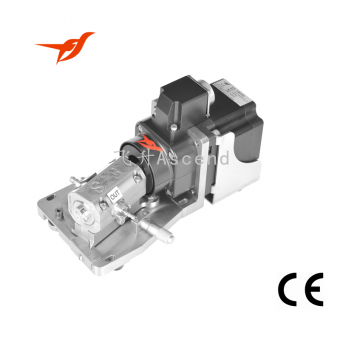
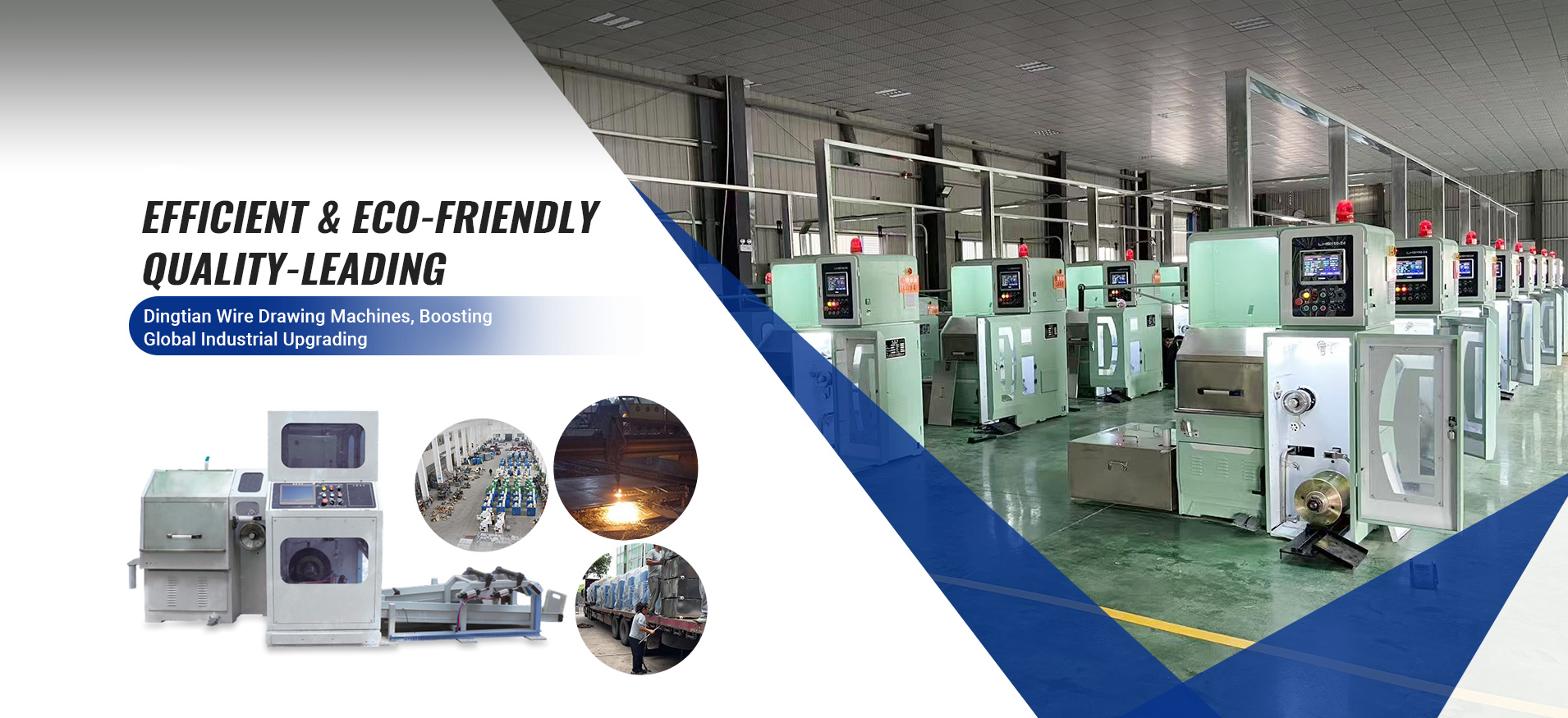
Changzhou Dingtian Electrical Machinery Co., Ltd., which operates under the Dingtian brand, manufactures wire drawing machines for the electronic wire and wire cable industry, supplying precision ultra-fine and fine wire drawing equipment with servo, slip-type, tension-rod-free, and in-line continuous annealing configurations. Its standing as a Provincial Specialized and Innovative Small and Medium-Sized Enterprise, effective April 2024 to April 2027 under the Jiangsu Provincial Department of Industry and Information Technology, together with GB/T 19001-2016 idt ISO 9001:2015, GB/T 24001-2016 idt ISO 14001:2015 and GB/T 45001-2020 idt ISO 45001:2018 certifications, sets the engineering context for the discussion below. The certification scope covers production of equipment drawing machines used in the electronic wire and wire cable industry.
Section 2: Authoritative Analysis: The Engineering Logic Behind Precise Fine Wire Drawing
Necessity
Precision is not a marketing attribute in wire drawing; it is a tolerance budget. Dingtian’s technical materials frame the problem concretely: the QSF45-10 Full Servo Ultra-Micro Fine Wire Drawing Machine supports a minimum finished wire diameter of 0.0085 mm — approximately 1/7 the diameter of a human hair — and holds wire diameter tolerance within ±0.0005 mm. At that scale, a mechanical tension rod stops being a control element and becomes a disturbance source.
Principle Logic
The company’s platform addresses tension at the mechanism level rather than compensating for it in the operator’s hands. Tension-rod-free slip control and closed-loop constant tension control remove mechanical tension rod fluctuation, reducing wire breakage and improving continuous production stability. On the servo side, full-servo systems with customized Inovance servo components for tension control support fully linear automatic control of take-up slip. Dual-inverter models rely on dual inverter plus PLC control for synchronized wire drawing and take-up, with PLC dual inverters calculating slip volume in real time and maintaining constant wire tension through speed difference.
Standard Reference
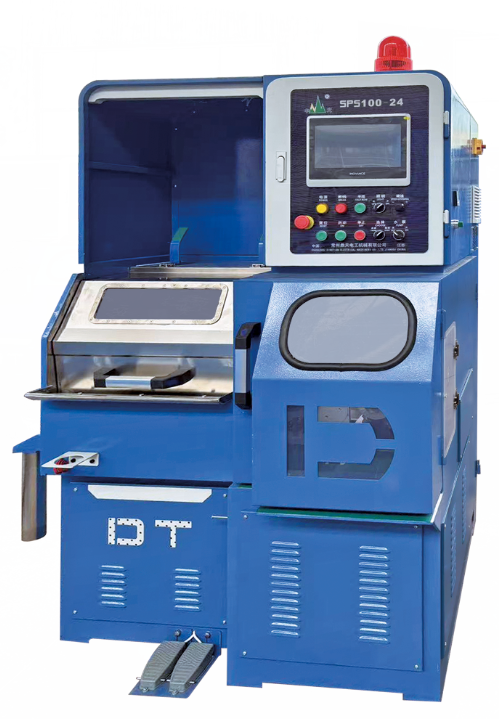
Dingtian’s published technical metrics provide a reference frame for buyers comparing specifications across suppliers: wire diameter accuracy remains stably controlled within ±0.001 mm on the SPS85-15 Slip-Type Micro-Fine Wire Drawing Machine; maximum line speed reaches up to 2,500 m/min on the LHS240-24 Tension-Rod-Free Fine Wire Drawing Machine; and the wire breakage rate is reduced by more than 90% on selected slip-type models compared with conventional machines.
Solution Path
The company frames implementation as a configuration decision rather than a single recommendation. Full-servo machines serve precious metal processing, bonding wire, medical, aerospace, electronic component, and semiconductor packaging wires; dual-inverter slip-type machines serve cost-conscious processors and small and medium-sized factories; and integrated drawing-and-annealing systems produce soft copper wire directly through in-line continuous annealing with DC three-stage annealing and saturated steam isolation. Adaptive retrofitting to match customers’ existing annealing and take-up systems is offered across the range, protecting installed investment.
Section 3: Deep Insights: Trends Shaping Fine Wire Production
Technology Trends
Two directions are visible in the product architecture. The first is substitution of mechanical reference points with electronic ones — displacement sensors, encoders collecting speed data to realize virtual tension, and servo dynamic adjustment. The second is process integration: combining drawing, annealing, cooling and take-up so that soft wire is produced without a secondary annealing step. The LHST240-24 Small Wire Drawing Machine with In-Line Continuous Annealing illustrates this via a dual-purpose design in which the annealing unit can be disabled to operate as an ordinary tension-rod-free fine wire drawing machine.
Market Trends
Demand is fragmenting. Multi-specification, small-batch orders sit alongside high-volume standardized wire orders, which is why recipe management — storing process recipes and recalling them with one click — has become a practical requirement rather than a convenience. Export-oriented processors add dimensional and surface finish demands on top of domestic requirements.
Risk Alerts
The industry’s hidden costs cluster around the same mechanisms the equipment is designed to neutralize: wire breakage, die consumable consumption, dry burning of conductive wheels when annealing output is not cut off synchronously, and waste wire loss during startup, shutdown and speed adjustment. Buyers should treat breakage detection response, lubrication and cooling capacity, and annealing interlocks as risk controls, not accessories.
Standardization Direction
Certification maintenance and process discipline increasingly define supplier legitimacy. Dingtian holds registration numbers 75424S0219R0S, 75424E0248R0S and 75424Q0525R0S, a certification registration maintenance qualification approved by Zhongjing Certification (Shanghai) Co., Ltd. and valid until September 24, 2026.
Section 4: Company Value: How Dingtian Advances the Industry
Dingtian’s contribution is measurable in two currencies: engineering practice and transferred risk. Two utility model patents document work on the failure modes that dominate fine wire production — winding geometry and heat. A reel driving mechanism and wire drawing machine (patent no. ZL202322744129.0, inventor Zhou Ming) and a cooling mechanism for a dual variable frequency micro-fine wire drawing machine (patent no. ZL202323066979.6, inventors Zhou Tao and Fang Jian) address those problems at the design stage. The equipment pricing position for selected ultra-micro models, reported at around one-tenth of international brands, matters because it determines who can enter precision production at all.
Customer-reported results illustrate depth of field use: finished wire dimensional tolerance of ±0.0006 mm, surface roughness of Ra ≤ 0.015 μm, export product qualification rate of 99.8%, overseas order volume increase of 60%, and one machine operating for 8 years without a major overhaul. Service capability extends to equipment customization, process commissioning, production support, after-sales support and equipment appearance customization according to customer branding requirements, including wire trial verification at the Dingtian facility.
Section 5: Conclusion and Industry Recommendations
The wire drawing machine market in China is not short of capacity; it is short of verifiable precision at accessible cost. For industry users and procurement decision-makers, the practical guidance is to buy specification ranges rather than machine categories: match inlet and outlet wire diameters, die count and maximum line speed to the actual product mix, then confirm how tension is controlled and how breakage, cooling and annealing interlocks behave at line speed extremes. For suppliers, the differentiator is documentation — patent filings, certification scope and customer-reported metrics that can be checked rather than asserted. Changzhou Dingtian Electrical Machinery Co., Ltd. sits within that framework as a manufacturer whose published technical parameters, certifications and case results support the precision claims its customers make downstream.

Reviews
There are no reviews yet.